
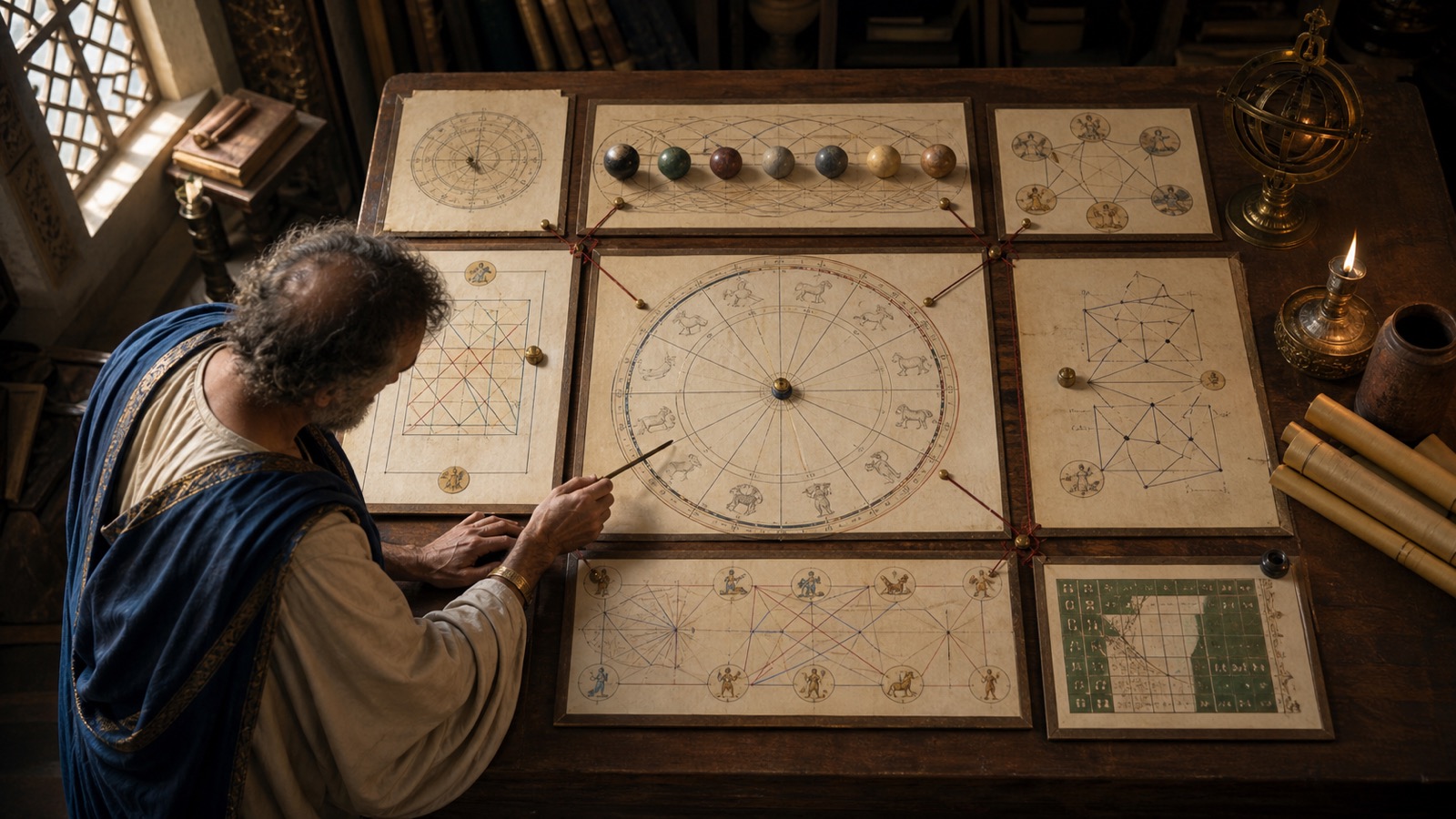
Synthesis is an ordering discipline. It begins with the chart-wide frame and keeps every later observation attached to the ruler, place, configuration, and calculation that produced it.
A six-stage reading order
- Establish the Ascendant, its ruler, and the ruler’s destination.
- Orient sect and inspect both luminaries.
- Follow all twelve house rulers and note where subjects converge.
- Judge each planet through separate condition evidence rather than a total score.
- Add degree-sensitive configurations and the Hermetic Lots.
- Add annual and releasing time only after the natal structure is established.
Preserve contrary testimony
A planet can hold several forms of testimony at once. Stelliums does not erase a difficult placement because another factor is supportive, or reverse that logic. The workspace links back to the exact evidence so the astrologer remains responsible for judgment.
Governed worked example
Worked example: assemble evidence without flattening it
The fixture begins with Taurus rising and a day sect. Venus rules the Ascendant from House 10; three planets occupy House 9; Jupiter in Cancer is opposite the Capricorn group; Fortune is also in House 9.
- Frame: Taurus rising, Ascendant ruler Venus in Aquarius House 10, day chart.
- Topology: trace every house ruler, including the House 1 path to Venus in House 10.
- Condition: retain Saturn domicile, Jupiter exaltation, and every separate Phase 2 axis.
- Configurations and Lots: preserve all twelve sign relationships plus Fortune and Spirit.
- Timing enters only after this natal evidence map is stable.
Sect-light triplicity integration
Whole-chart synthesis now places the Dorothean triplicity rulers immediately after the two luminaries. This order makes the sect hierarchy visible before house-ruler, condition, configuration, Lot, and timing layers are combined.