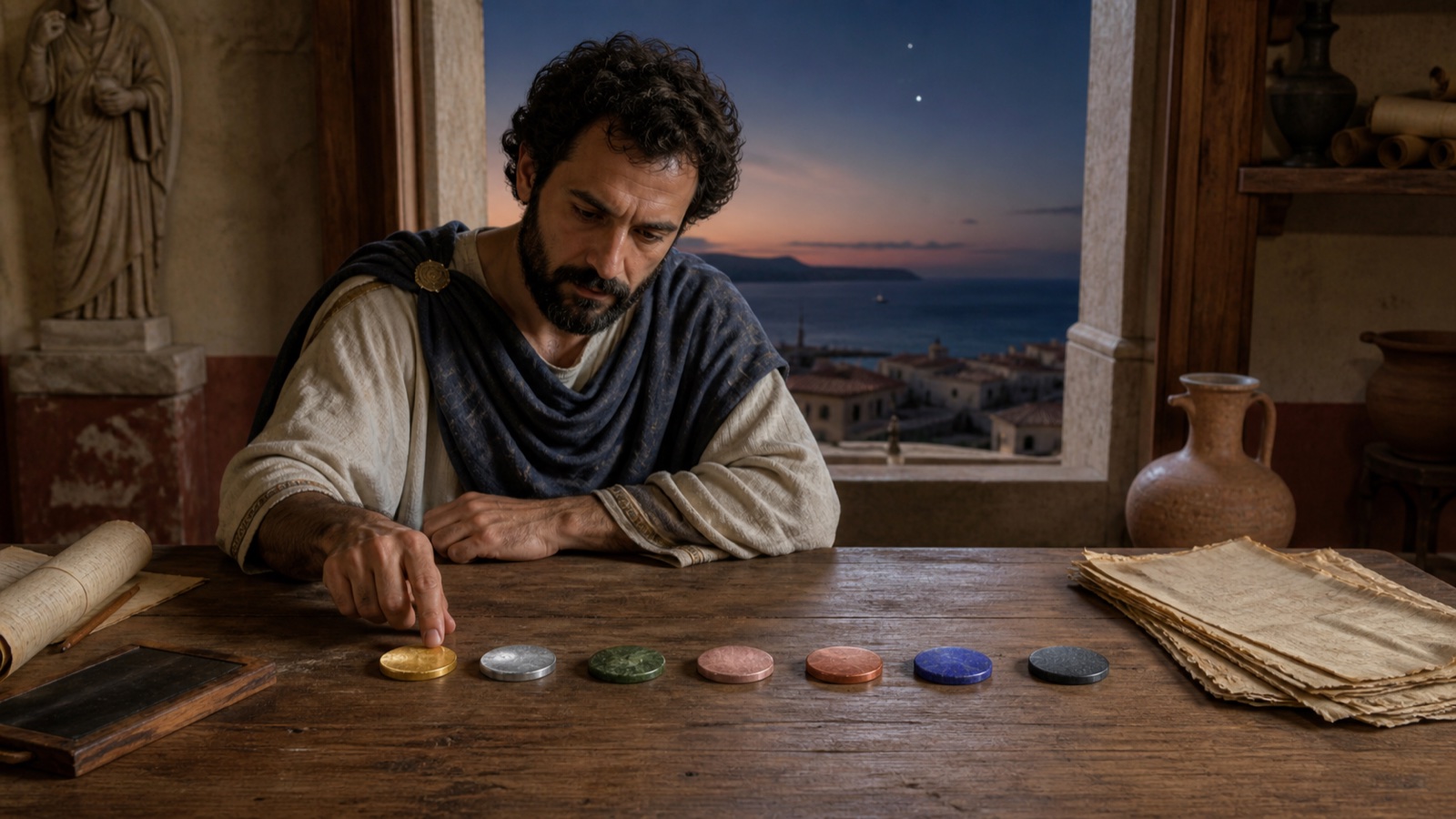
Stelliums centers the seven traditional visible planets: Sun, Moon, Mercury, Venus, Mars, Jupiter, and Saturn. Their meanings are judged through placement, rulership, sect, and configurations rather than reduced to personality adjectives.
- Sun — authority, visibility, vitality, honor, leadership, and directed purpose.
- Moon — body, nourishment, daily circumstance, change, reception, movement, and responsiveness.
- Mercury — speech, writing, calculation, learning, trade, craft, interpretation, and mediation.
- Venus — union, affection, pleasure, beauty, art, agreement, fertility, and social ease.
- Mars — heat, severing, conflict, courage, competition, urgency, injury, and forceful action.
- Jupiter — growth, justice, counsel, faith, prosperity, generosity, protection, and legitimate authority.
- Saturn — constraint, delay, scarcity, labor, age, boundaries, solitude, endurance, and consolidation.
A planet is never read alone
A planet in a sign tells you something different from a planet in a house. Its sign describes condition and mode; its Whole Sign house shows where its topics operate; its rulership shows which other houses it carries; its configurations describe planetary testimony.
Governed worked example
Worked example: inventory the visible planets first
The same fixture contains exactly the seven traditional planets. A disciplined first pass records where each one is before assigning topics or combining testimony.
- Sun 25 degrees Capricorn, House 9; Moon 20 degrees Virgo, House 5.
- Mercury 11 degrees Capricorn retrograde, House 9; Venus 0 degrees Aquarius retrograde, House 10.
- Mars 20 degrees Sagittarius, House 8; Jupiter 3 degrees Cancer retrograde, House 3; Saturn 17 degrees Capricorn, House 9.