
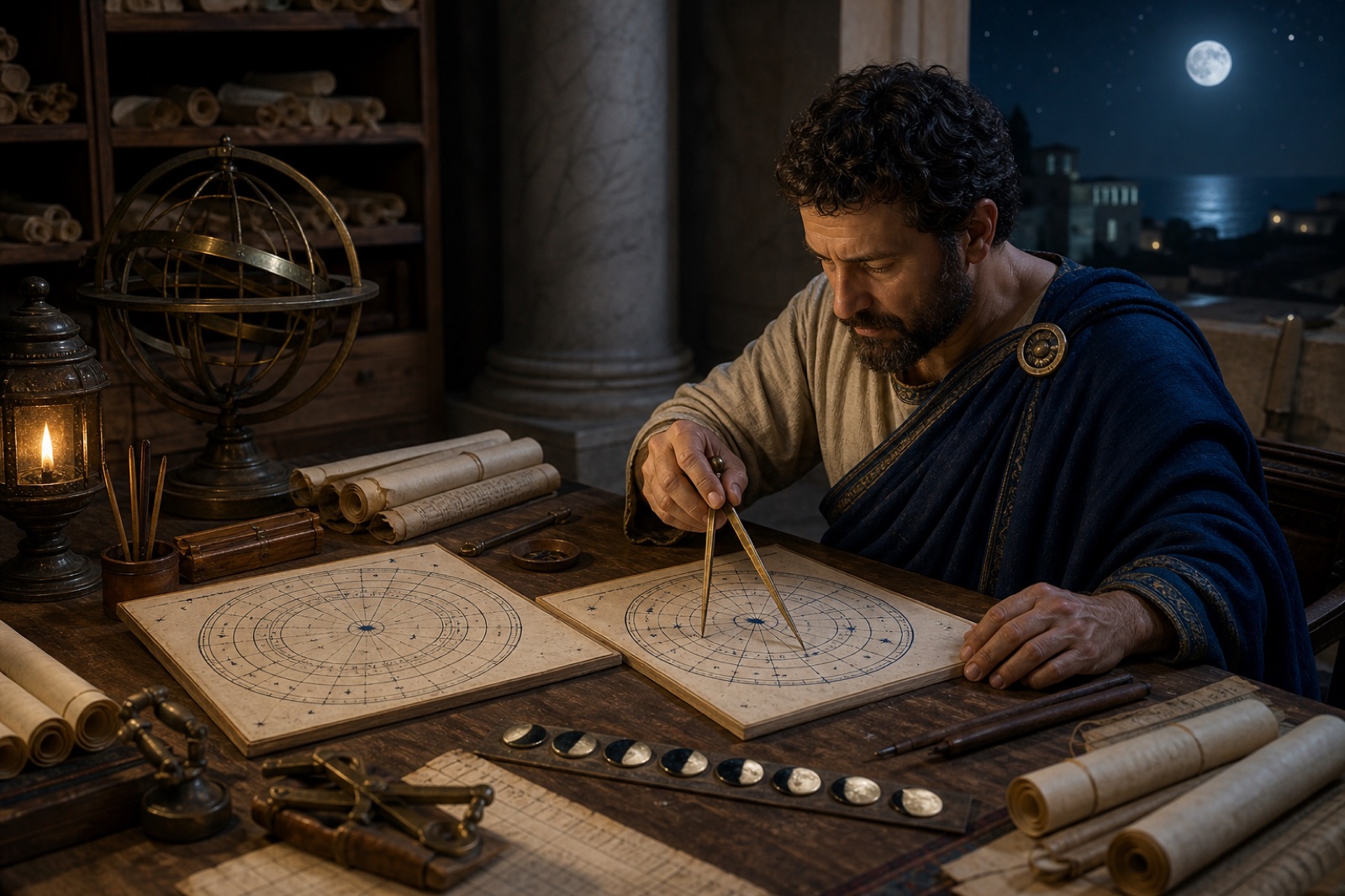
A lunar return workspace starts with one exact saved natal fact: the tropical geocentric longitude of the Moon. Stelliums searches strictly before or after a timezone-aware anchor until the Moon returns to that longitude, then calculates a new chart for the solved instant.
Why the anchor and direction are explicit
The Moon returns to a natal longitude roughly once per sidereal month, so a calendar-month selector can contain zero, one, or two crossings. A strict previous-or-next search from a disclosed UTC anchor identifies one unambiguous result and supports reproducible adjacent-return navigation.
What location changes
The recurrence instant and planetary longitudes do not change with location. The selected place supplies the local civil time, Ascendant, Midheaven, Whole Sign places, and the Sun altitude used for sect. Stelliums records the label, coordinates, timezone, UTC instant, and local instant together.
Governed worked example
Worked example: preserve the target and move the location
The frozen calculation fixture targets a natal Moon at 246.75 degrees from an anchor of 2026-08-28 12:00 UTC. Previous and next searches land on opposite sides of the anchor, each with sub-milliarcsecond residual. Repeating the next calculation for Chicago and London preserves the exact recurrence while changing the angles and local civil time.
- Preserve the natal Moon longitude as the recurrence target.
- Choose a UTC anchor and strict previous or next direction.
- Audit the solved UTC instant, residual, iteration count, and three-hour bracket.
- Read the return chart as a separate chart and compare only the disclosed contacts to the preserved nativity.
A disciplined evidence order
- Keep the nativity visible as the lasting structural foundation.
- Verify the recurrence provenance and selected location.
- Inspect the return Ascendant, its ruler, sect, Moon, and angular planets as return-chart facts.
- Compare return planets to natal planets through the governed traditional sign relationships.
- Treat any broader timing synthesis as a separate, human judgment task.
Place the return inside annual and monthly time
At the exact lunar recurrence, establish the annual profected place in the nativity first. Then identify the active monthly period inside that annual frame. Keep both lords in their unchanged natal positions before inspecting those same planets in the separate return chart.
- Annual profection — the superior natal frame for the year.
- Active monthly profection — a subordinate period inside that annual frame.
- Annual and monthly lords in the nativity — their lasting natal condition and responsibilities.
- The same lords in the return — separate return signs and houses.
- Return Moon and Ascendant ruler — return-chart roles that may repeat one or both time lords.
- Activated-sign and contact lanes — factual comparison evidence across the two distinct charts.