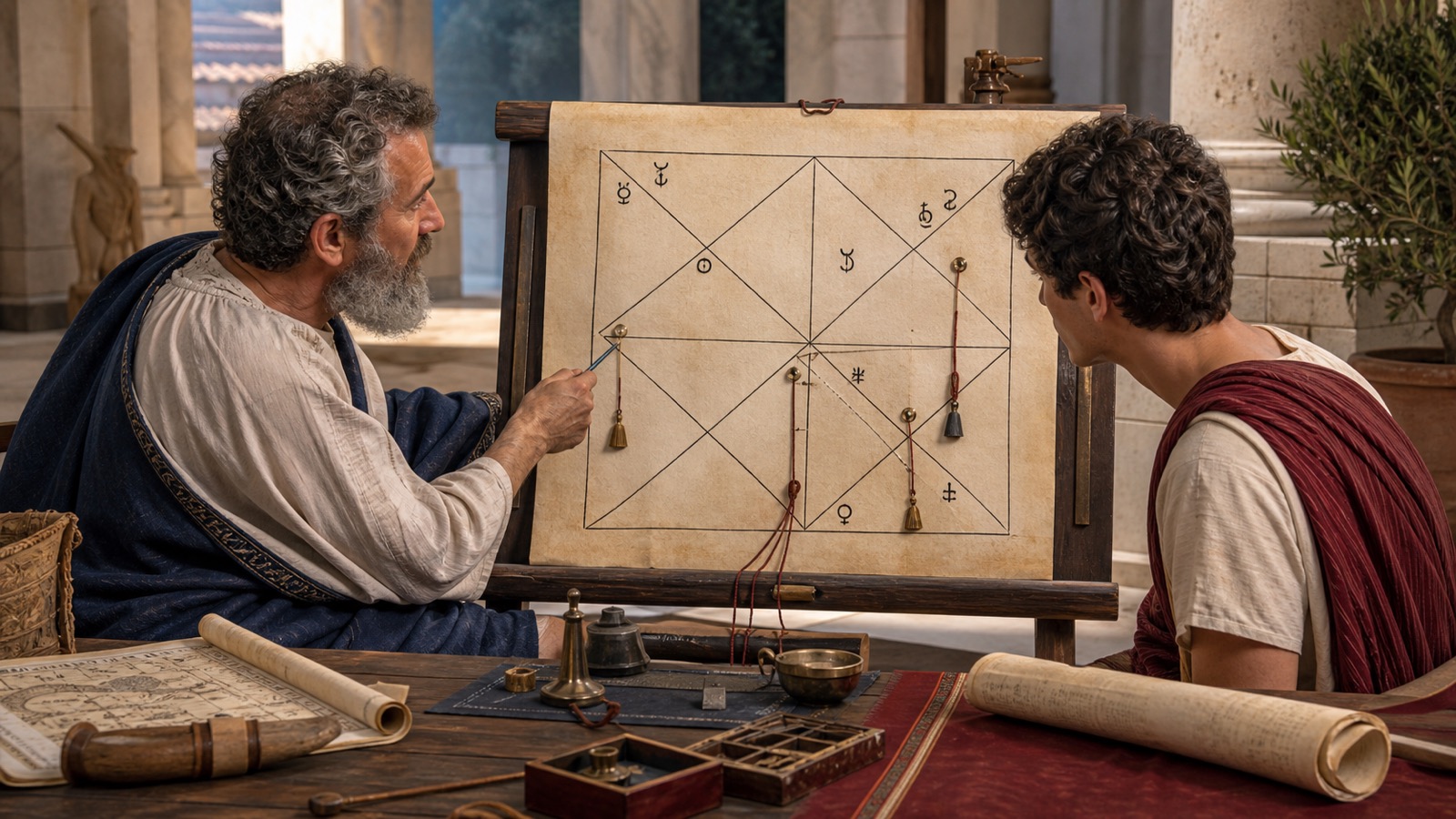
A Hellenistic natal chart is not read by collecting isolated descriptions. The same planet can signify different things depending on which houses it rules, where it is placed, whether it is supported by sect, and which planets it sees by traditional configuration.
A useful reading order
- Establish the Ascendant and Whole Sign house sequence.
- Identify sect and the day/night planetary condition framework.
- Locate the seven traditional planets by sign and Whole Sign house.
- Follow domicile rulers to see how house topics connect.
- Inspect traditional sign-based configurations among the planets.
- Add the Lots of Fortune and Spirit with their rulers.
- Only then synthesize the strongest repeated structural themes.
Why Stelliums separates facts and interpretation
The calculation engine stores astronomical and structural facts. Governed interpretation content is versioned separately. Presentation logic can then organize those facts without pretending that a generated paragraph is itself a calculation.
Governed worked example
Worked example: complete the canonical reading sequence
Use the Dallas 1990 golden fixture as a repeatable practice chart. Each step below corresponds to a calculation workspace and can be checked against the frozen engine facts.
- Establish Taurus rising, Venus as Ascendant ruler in House 10, and day sect.
- Inventory the seven planets and inspect sign condition plus separate Phase 2 evidence.
- Trace all twelve ruler paths and the Capricorn House 9 concentration.
- Judge the twelve governed sign relationships before degree-sensitive qualifiers.
- Place Fortune in Capricorn House 9 and Spirit in Virgo House 5.
- Only then add profections, transits, or releasing as later time layers.