
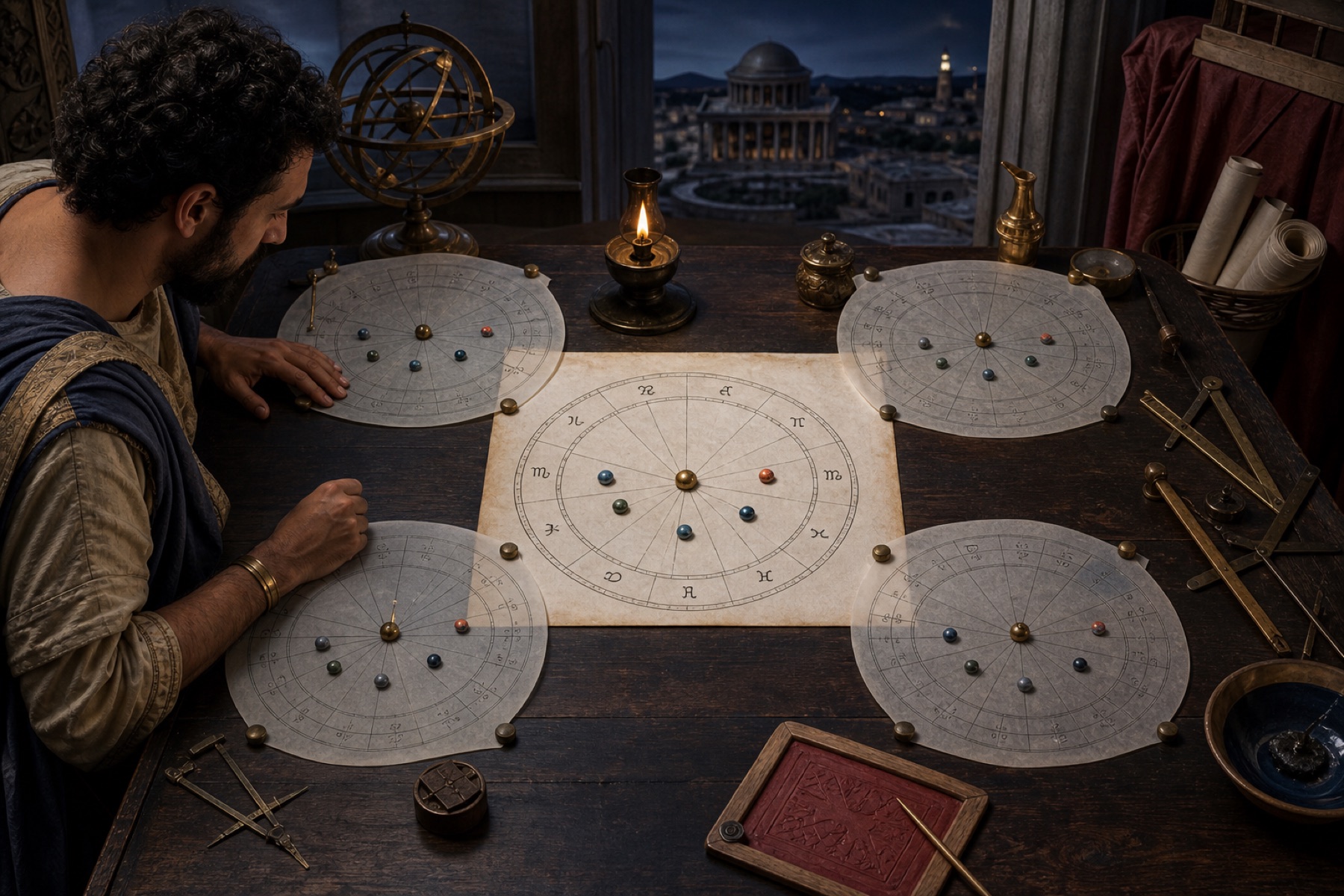
A natal chart can preserve more than one geometric description without pretending they all perform the same interpretive job. Stelliums keeps Whole Sign places as the governed topical map and offers five Swiss-calculated cusp systems as optional technical comparison layers.
What the selector changes
- Equal begins thirty-degree houses at the exact Ascendant.
- Porphyry trisects the ecliptic arcs between the four angles.
- Alcabitius, Regiomontanus, and Placidus use their own named Swiss Ephemeris house calculations.
- Selecting an overlay changes only the visible cusp layer; it does not move planets, rewrite the saved calculation, or replace Whole Sign topics.
Governed worked example
Worked example: one Sun, several house ledgers
In the frozen Dallas 1990 fixture, the Sun is at 25°21′ Capricorn in Whole Sign place 9. The Sun is in Equal house 9, while Porphyry, Alcabitius, Regiomontanus, and Placidus each place it in house 10. The longitude has not changed; only the system used to divide the local celestial frame has changed.
Worked boundary: do not disguise an undefined result
For the frozen Tromsø high-latitude fixture, Equal, Porphyry, Alcabitius, and Regiomontanus remain available. Placidus is unavailable and no substitute cusps are emitted. The selector disables that layer and names the reason instead of presenting fallback geometry under the Placidus label.
A disciplined comparison
- Begin with the Ascendant sign and Whole Sign place structure.
- Open Chart display settings and select one technical overlay.
- Inspect both the cusp drawing and the calculated per-planet house ledger.
- Name the system whenever discussing a quadrant or equal-house position.
- Treat differences as outputs of different division rules, not as permission to choose a preferred story.