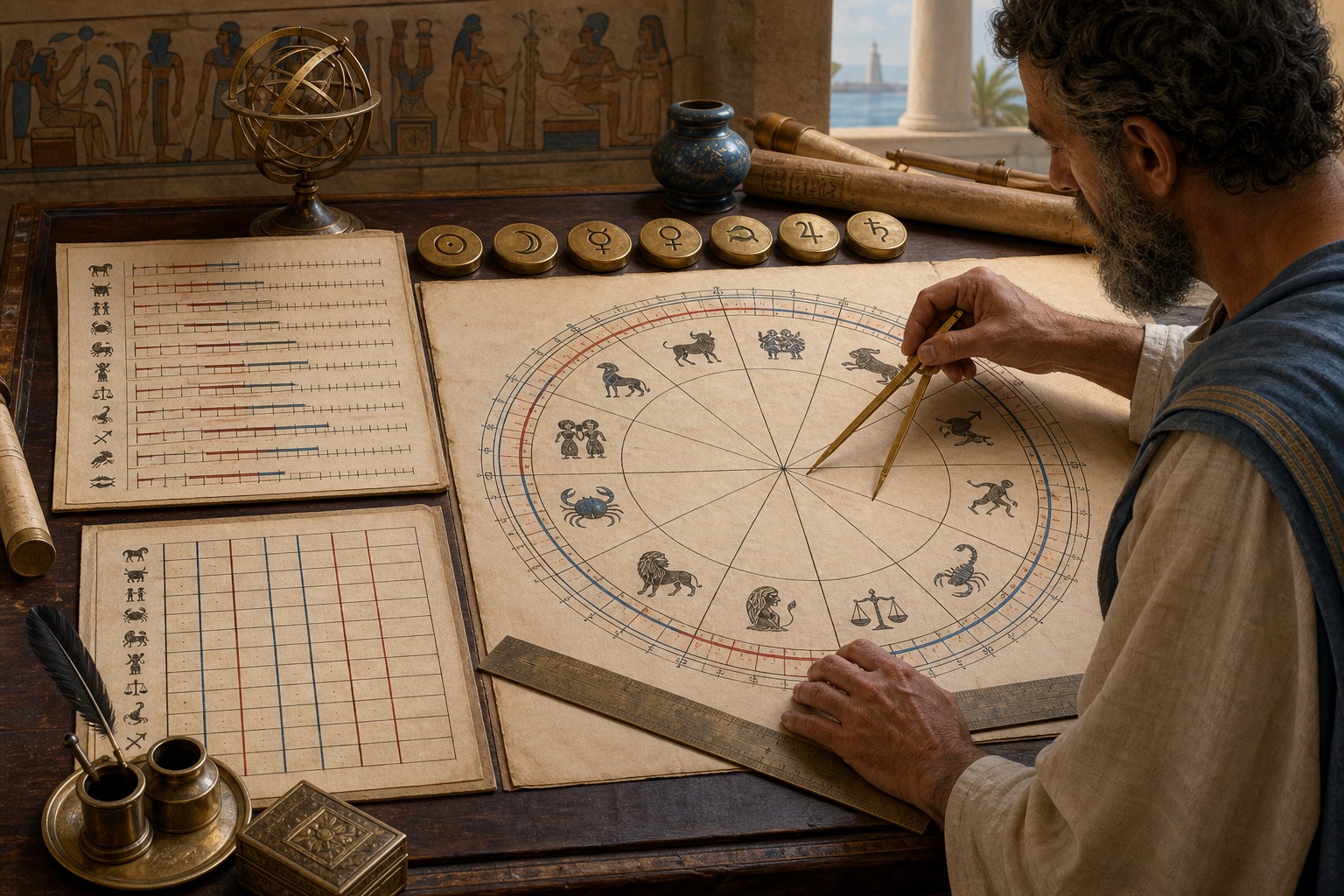
Bounds and faces divide each zodiacal sign by degree, but they do not use the same geometry. The Egyptian bounds form five unequal intervals ruled only by Mercury, Venus, Mars, Jupiter, and Saturn. The Chaldean faces form three equal ten-degree decans and repeat the seven-planet Chaldean order continuously around the zodiac.
Two ledgers, two questions
- Locate the planet at its exact degree within the sign.
- Resolve the Egyptian bound from that sign-specific unequal table.
- Resolve the Chaldean face from the global repeating decan order.
- Record each ruler, interval, and boundary distance separately.
- Mark own-bound or own-face testimony only when the planet itself rules that exact segment.
- Return both testimonies to the wider condition judgment without totaling them.
Why the endpoint rule matters
Every segment includes its lower endpoint and excludes its upper endpoint. A planet exactly at 24 degrees Leo is therefore in the Mars bound beginning at 24 degrees, not the Mercury bound ending there. A position at exactly 20 degrees enters the third face, and 30 degrees belongs to the next sign.
Governed worked example
Worked example: the frozen report fixture
The frozen fixture Sun is at 25 degrees Leo. Leo has a Mars Egyptian bound from 24 through the end of the sign, so the Sun is 1 degree into that bound with 5 degrees remaining. The third Leo face spans 20 to 30 degrees and is also ruled by Mars. The matching ruler is recorded twice because two independent tables produce it; the testimonies are not merged.
- Exact position: Sun at 25 degrees Leo.
- Egyptian bound: Mars, 24 to 30 degrees.
- Chaldean face: Mars, third decan, 20 to 30 degrees.
- Own-bound and own-face are both false because the planet is the Sun.
- The result remains two named evidence fields, not a doubled score.