
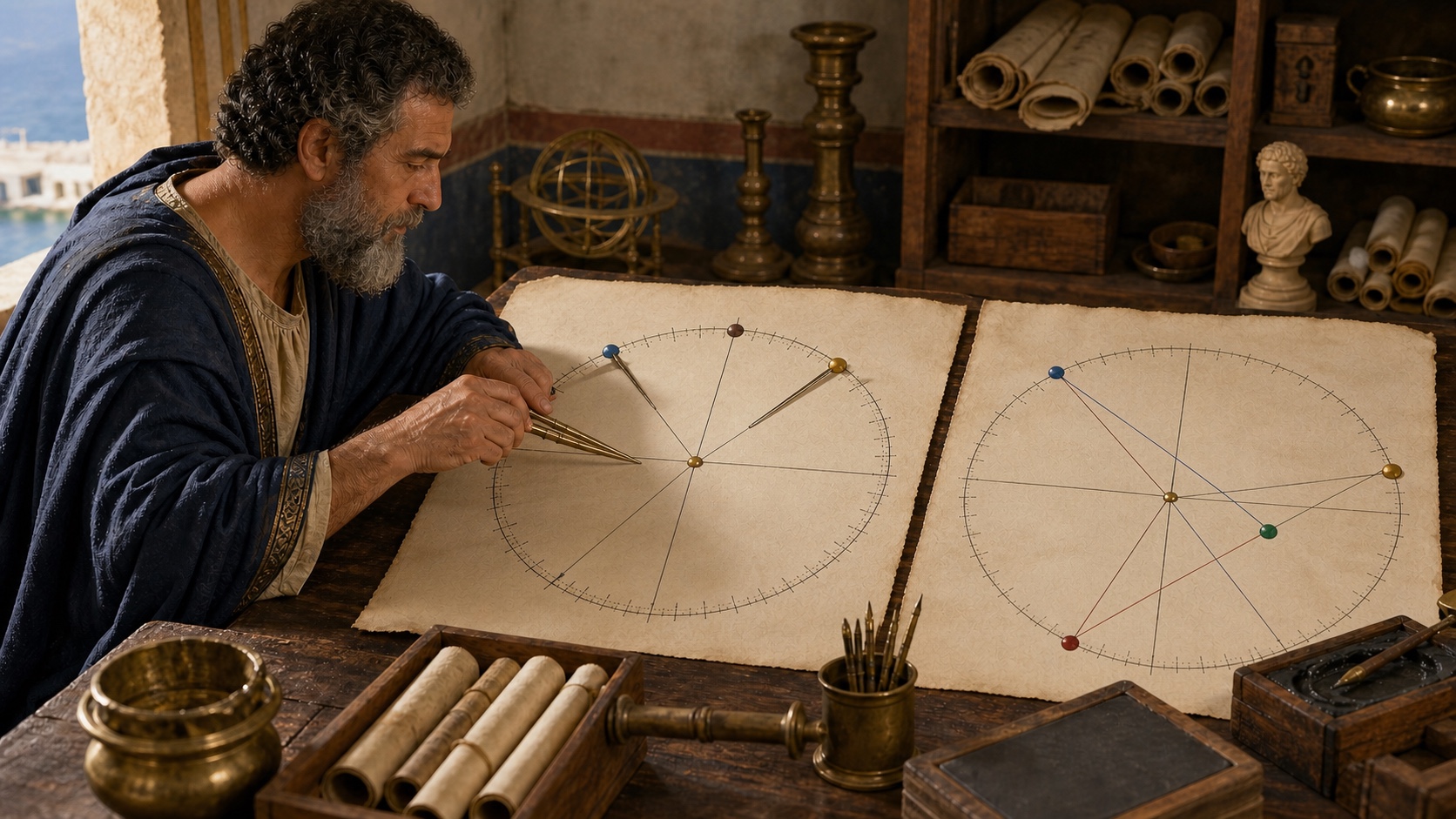
Porphyry distinguishes close planetary adherence from enclosure by rays. Stelliums calculates both as visible evidence lanes inside the planetary-condition workbench, retaining the exact bodies, aspects, distances, motion phase, and any intervention.
Adherence within three degrees
Adherence requires an exact or applying traditional contact no more than three degrees from exact. The faster planet must be approaching the slower planet. A separating contact does not satisfy this governed adherence rule, even when it remains close.
Ray enclosure within seven degrees
For a target planet, Stelliums generates the configured sextile, square, trine, and opposition rays of Venus and Jupiter, then separately of Mars and Saturn. A potential enclosure exists when one ray from each member of a pair falls within seven degrees on opposite sides of the target.
Intervention remains visible
A third planetary body or configured ray strictly inside the interval intervenes. Stelliums keeps the candidate visible, names the intervening planet and ray or body, and marks the enclosure canceled instead of silently deleting it.
Governed worked example
Worked example: active and canceled geometry
In the synthetic method fixture, a target at 100° lies between Venus and Jupiter rays at 96° and 105°. Both are within the inclusive seven-degree boundary, so the benefic-pair candidate is active when no other testimony lies inside the interval.
- Add a Mars configured ray at 102° inside the same interval.
- The candidate remains displayed, but intervention cancels the active enclosure.
- Read the named rays and distances before returning to sect, place, dignity, motion, reception, and the complete nativity.
Reading order
- Confirm the target and each named planet.
- For adherence, verify the traditional contact, exact deviation, and applying phase.
- For enclosure, verify both pair members, their ray aspects, and their signed distances from the target.
- Inspect every intervening body or ray.
- Return to the complete condition dossier before forming a qualitative judgment.
Bodily enclosure is a separate form
The bodily form asks which planetary bodies immediately flank the target in zodiacal order. A governed candidate exists only when those unique nearest neighbors are Venus and Jupiter or Mars and Saturn. Stelliums displays both exact arc distances but imposes no degree orb, because the source gives the seven-degree measure to the alternative ray form rather than to the bodily wording.
Ray intervention can cancel the bodily candidate
After finding the nearest enclosing bodies, Stelliums inspects the interval for a configured ray from another traditional planet. The candidate remains visible and is marked canceled when such a ray intervenes. Co-located or tied nearest bodies remain unresolved rather than being forced into a result.
- Identify the target planet.
- Find the unique nearest planetary body behind it and ahead of it in zodiacal order.
- Confirm that the pair is Venus-Jupiter or Mars-Saturn.
- Read both exact distances without applying an orb.
- Inspect every named intervening ray.
- Return the geometry to the full condition and topical dossier without converting it into a verdict.